
In a generation witnessing a resurgence of young Indian classical musicians, Sadakat Aman Khan, widely celebrated as Mr. Harmonium, has emerged as one of the most compelling voices redefining the harmonium’s role on contemporary global stages. Born into a distinguished musical family, he carries forward an illustrious lineage, yet his artistic personality remains unmistakably his own. Critics often commend his clarity of tone, meditative phrasing, and depth of improvisational thought, qualities that set him apart in today’s fast-accelerating performance culture.
From his formative years in Malda to a growing concert footprint across Europe, Sadakat embodies an artist who remains rooted in tradition while courageously exploring new creative terrains. As a critic who has reviewed classical musicians for over two decades, I found myself particularly intrigued by his ability to infuse vocal sensitivity into an instrument frequently dismissed as restrictive. In a candid online conversation from London, Sadakat opened up about his artistic decisions, his vulnerabilities, and his evolving journey.
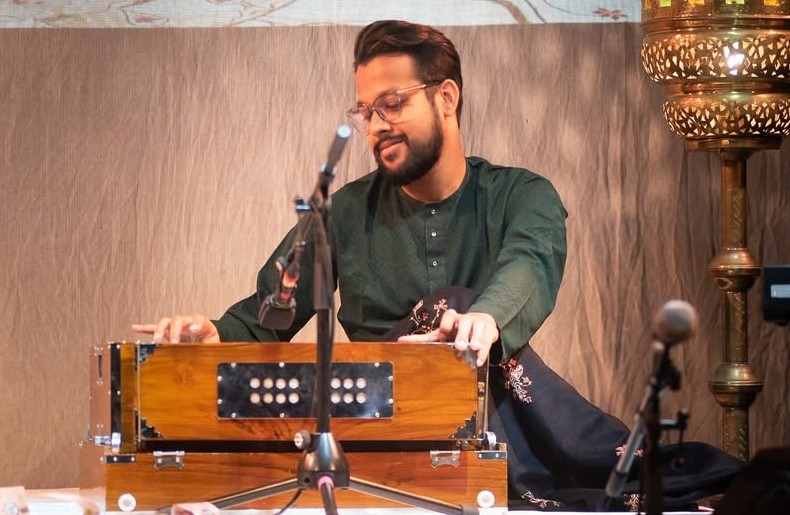
A Conversation with Sadakat Aman Khan
Introspection as an Artistic Identity
Q: Many critics in Delhi, myself included, often describe your playing as unusually introspective for someone your age. Do you feel introspection works more as a strength or as a limitation?
Sadakat: It’s really just where my music begins. Introspection grounds me, it makes me choose intention over speed. At the same time, I understand why some listeners feel it can hold things back. I’m learning to strike a balance between thought and instinct. Growth happens when you acknowledge both your strengths and your weaknesses honestly.
The Pursuit of Tonal Purity
Q: Something that comes up repeatedly in reviews is your tonal purity, especially during those long sustained phrases. How did you develop that level of control?
Sadakat: Honestly, through years of slow, steady practice. My mother, Najhum Ara Razi, always emphasized clarity over quantity. She would say, “Let each note carry its own weight.” That stayed with me. Because of her, I learned to appreciate stillness and patience, and those qualities naturally shaped the kind of tone I aim for.
On Predictability in Improvisation
Q: A few listeners feel your improvisations, while elegant, can sometimes be predictable. What’s your reaction to that?
Sadakat: I think it’s a fair observation. I do tend to choose safety over surprise at times. My ideas are influenced heavily by vocal music, which often follows structured patterns. I’m working on widening my creative vocabulary so that spontaneity feels more instinctive and not something I have to consciously push.
The Art of Slowing Down
Q: Your London recital received great appreciation for its emotional depth, but some critics also mentioned that the pace felt slower than expected. Was that a deliberate choice?
Sadakat: Yes, very much so. I think of each raag as a conversation, some conversations need time to unfold. I don’t like rushing the audience or myself. When listeners settle into the pace, it becomes meaningful; if they don’t, it can feel heavy. I understand both reactions and accept that the experience will vary from person to person.
Challenging the Instrument with Raag Madhuvanti
Q: You recently performed Raag Madhuvanti on the harmonium, which isn’t easy due to its smooth transitions. Why choose such a challenging raag for this instrument?
Sadakat: The harmonium won’t grow if we keep avoiding difficult ragas. I wasn’t chasing perfection, I was exploring what the instrument could express. Even when the harmonium resists, that struggle teaches you something. Challenging it is the only way to expand its possibilities.
Bellows Technique and Dynamics
Q: Your bellows technique is admired for being extremely quiet, though some people feel it limits dynamic range. Do you agree with that?
Sadakat: In a way, yes. A gentler bellow gives me more control, but it definitely limits volume. Personally, I prefer nuance. I want the harmonium to feel as close to the human voice as possible. Volume can always be added, but sensitivity has to come first.
Internal Rhythm and Layakari Influence
Q: One thing that stood out to me as a critic was your internal sense of rhythm. How much conscious work goes into maintaining that?
Sadakat: Quite a lot, actually. Even in slow passages, I hold an internal rhythmic grid in my mind. Years of listening to my father’s layakari shaped that habit. For me, rhythm isn’t just speed, it’s direction. I think critics notice this because I don’t let phrases float without purpose.
Artistic Vulnerability and Growth
Q: What’s one artistic weakness you feel you need to work on right now?
Sadakat: I want to sharpen my articulation in faster passages. I’m naturally drawn to lyrical phrasing, but classical music also demands crispness. So I’m working on bridging that gap through new practice routines.
The Future of the Harmonium
Q: Looking ahead, how would you like audiences and critics to view the harmonium?
Sadakat: I hope people start seeing it as an instrument with real emotional depth, not just as accompaniment. Yes, it has limitations, but it also carries a warmth that’s very unique. With honest attention and effort, the harmonium can absolutely hold its own as a solo instrument.
Disclaimer
The views, opinions, artistic interpretations and statements expressed in this interview are solely those of the featured Artist and the interviewer in their individual capacities. They do not necessarily reflect the official policy, position, or endorsement of this publication or its editorial team. Any references to musical practices, critiques, or personal experiences are shared for informational and artistic purposes only. All content is presented in good faith, without intent to defame, misrepresent, or create controversy regarding any individual, community, or institution. Readers are encouraged to interpret the artistic perspectives within the context of the interview.