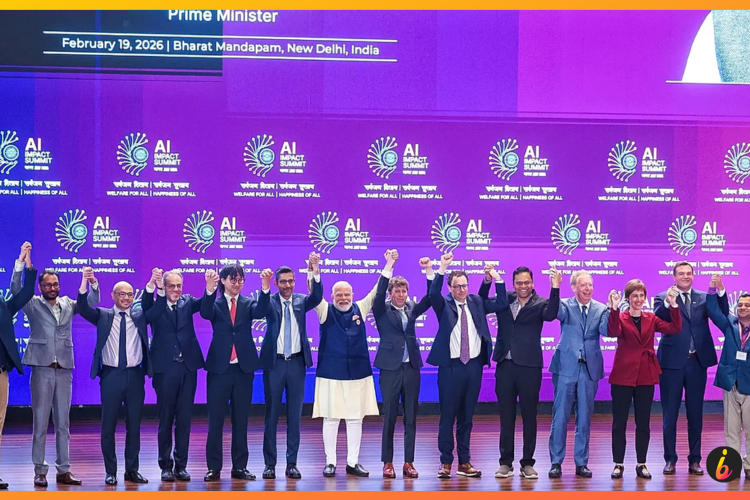
When the world gathered at Bharat Mandapam in February 2026, the India AI Impact Summit 2026 was more than a high-profile technology conference. It was a strategic statement: the future of Artificial Intelligence will not be decided by a handful of tech superpowers alone.
Hosted under the IndiaAI Mission by the Ministry of Electronics and Information Technology, the summit marked a decisive shift in global AI discourse; from theoretical safety debates to real-world impact, inclusion, and sovereign capability.
For a generation that sees AI as both opportunity and disruption, this summit signaled something deeper: India is positioning itself as the architect of Developmental AI.
From AI Safety to AI Impact: A Global Shift
The global AI summit circuit began with the AI Safety Summit at Bletchley Park in 2023, followed by Seoul in 2024 and Paris in 2025. Those conversations largely centered on frontier model risks, guardrails, and regulation.
India reframed the narrative.
Instead of asking, “How do we control AI?”, the India AI Impact Summit asked:
How do we deploy AI at population scale — responsibly and equitably?
This shift matters. Safety is critical, but for emerging economies, the bigger question is access. Who gets compute? Who builds models? Who benefits from automation? And who gets left behind?
AI Sovereignty: Compute Is the New Oil
One of the most significant outcomes of the summit was India’s expansion of its AI compute ambitions. With plans to scale GPU capacity through its national AI Compute Portal, India signaled that sovereign AI infrastructure is a strategic priority.
In the 20th century, nations fought for energy security.
In the 21st century, nations compete for computational independence.
For startups, researchers, and public institutions, access to compute determines innovation velocity. If AI infrastructure remains concentrated in a few global hyperscalers, then digital dependency becomes inevitable.
The India AI Impact Summit made it clear: the Global South wants participation — not just consumption.
Developmental AI: The India Model
What sets India apart is scale.
- 1.4+ billion citizens
- 22+ officially recognized languages
- Massive diversity in income, geography, and digital access
Deploying AI in this environment requires more than cutting-edge models. It requires contextual intelligence.
The summit showcased multilingual AI models, sector-focused applications in healthcare, agriculture, education, and sustainability, and practical use cases designed for real-world constraints.
This is not AI built only for billion-dollar enterprises.
This is AI built for:
- Rural healthcare diagnostics
- Climate-resilient farming
- Skill development and education access
- MSME automation
If AI solutions can work across India’s complexity, they can scale globally.
The Delhi Declaration: Setting the Tone for Global AI Governance
The summit culminated in a multilateral declaration emphasizing inclusive growth, ethical deployment, sustainability, and democratic access to AI systems.
While policy language often sounds ceremonial, the underlying signal was powerful: India is stepping into a convening role in global AI governance.
Rather than competing purely at the frontier research level, India is shaping the normative framework around deployment, especially for developing economies. In geopolitics, agenda-setting is influence.
Why This Matters to the New Age Generation
Gen Z and millennial professionals don’t see AI as abstract theory. They see:
- Automation reshaping jobs
- AI startups redefining entrepreneurship
- Creator tools amplifying individual productivity
- Climate tech powered by machine learning
The India AI Impact Summit 2026 speaks directly to this generation’s anxieties and ambitions. It acknowledges that AI is not just a Silicon Valley story. It is a global transformation — and India intends to be a central protagonist.
For founders, developers, and digital creators, this means:
- Expanding domestic AI infrastructure
- Growing investment ecosystems
- New opportunities in AI-driven public sector innovation
- A stronger push for ethical, inclusive AI design
Challenges and Reality Check
No summit of this scale is without friction. Logistical challenges, political protests, and civil society critiques highlighted the complexity of hosting a global technology forum in the world’s largest democracy.
But disruption often accompanies ambition.
The broader takeaway is not the operational hiccups — it is the directional shift. India is no longer a passive technology market. It is asserting itself as a policymaker, deployer, and ecosystem builder.
The Bigger Picture: A New AI World Order?
By 2030, AI success will not be measured only by model size or benchmark scores. It will be judged by:
- Productivity gains in emerging markets
- Climate resilience
- Healthcare reach
- Job creation in AI-enabled sectors
- Democratized access to digital tools
The India AI Impact Summit 2026 may well be remembered as the moment when AI governance expanded beyond elite risk frameworks into mainstream developmental policy.
The West built early AI dominance.
China industrialized AI at scale.
India is attempting to democratize it.
If successful, this could redefine global power dynamics in the AI era.
Final Thought: India’s AI Moment
The India AI Impact Summit 2026 was not just about announcements or optics. It was about positioning.
It positioned India as:
- A hub for inclusive AI innovation
- A voice for the Global South in AI governance
- A champion of AI for social good
- A nation investing in sovereign digital infrastructure
For the New Age audience — builders, dreamers, disruptors — this summit sends a clear message:
The future of AI will not be imported. It will be co-created.
And India intends to lead that charge.